Should Quote Preparation and Quote Management Be Handled in ERP or CRM?
- By ermadmin
19 Jun
Bayram Kont | CRM Consultant | LinkedIn Profile
Many companies still manage their quote preparation processes through one of two common approaches.
On one side, there are fragmented processes driven by Excel spreadsheets, Word documents, and long email chains.
On the other, there is a more structured approach that argues quotes should be created directly within ERP systems.
At first glance, the reasoning behind this second approach seems perfectly logical:
Product data resides in the ERP system.
Price lists are maintained in the ERP system.
Inventory information is stored in the ERP system.
Customer account and credit information are managed in the ERP system.
Therefore, quotes should also be prepared in the ERP system.
However, real-world experience often tells a different story.
Many organizations running powerful ERP platforms such as SAP, IFS, Logo, Mikro, and Netsis still have sales teams preparing quotes in Excel, even when quote management modules already exist within their ERP systems.
This does not mean ERP systems are inadequate.
The real issue is that quote preparation and quote management are not the same thing.
Preparing a quote is not simply a matter of selecting products and entering prices.
A quote represents a critical stage of the sales process where customer relationships, sales opportunities, pricing strategies, revisions, approval workflows, and the potential conversion to an order must all be managed together.
That is why the real question is not:
“Can quotes be prepared in an ERP system?”
Instead, the more important question is:
“Where can quote preparation be managed most effectively alongside sales activities, customer interactions, inventory visibility, pricing controls, approval workflows, and order processes?”
In this article, we take an objective look at quote preparation processes and evaluate ERP, CRM, and ERP-integrated CRM approaches based on real-world business experience.
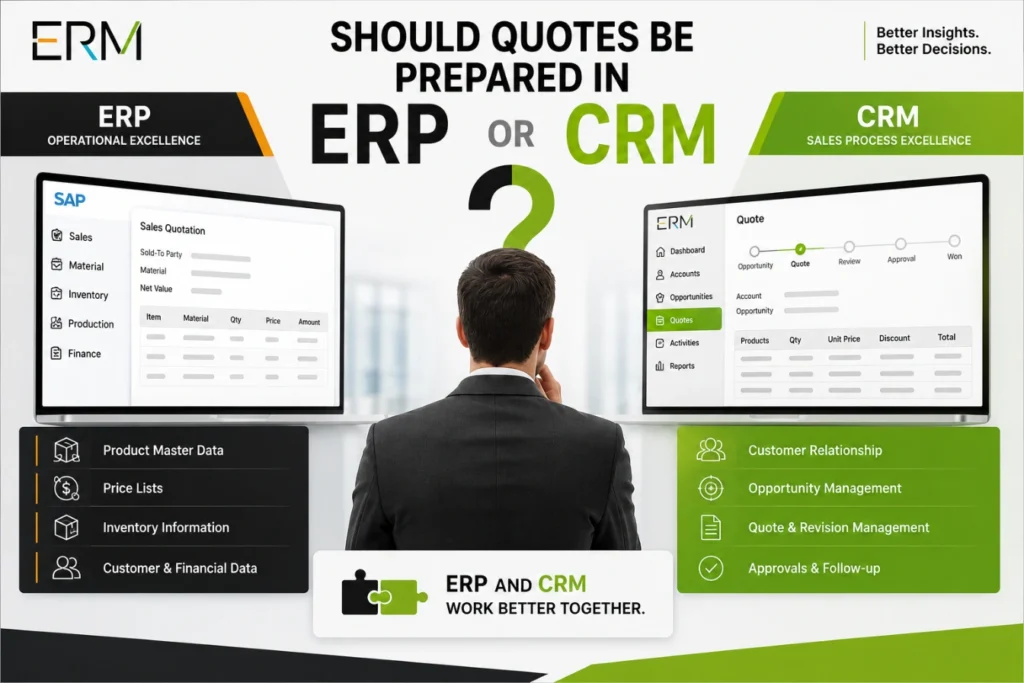
What Roles Do ERP, CRM, and ERP-Integrated CRM Play in the Quote Process?
| System | Primary Role |
|---|---|
| ERP | Manages orders, inventory, procurement, production, shipping, and financial operations |
| CRM | Manages sales opportunities, quote preparation, quote management, and customer relationships |
| ERP-Integrated CRM | Connects sales and operational processes within a unified workflow |
For mid-sized and large organizations, the most effective model for quote preparation and quote management is typically an ERP-integrated CRM architecture.
A Brief Note on ERP and CRM Terminology
In Türkiye, ERP systems are often described simply as “accounting software.”
In reality, ERP systems go far beyond accounting. They are operational management platforms that support inventory management, procurement, order processing, production, shipping, customer accounts, and financial operations.
Similarly, CRM is far more than a database of customer records.
CRM platforms are business applications used to manage leads, sales opportunities, quote preparation processes, customer interactions, activities, service operations, and long-term customer relationships.
Throughout this article, the terms ERP and CRM are used within this broader business context.
What Do Companies Really Need When They Search for Quote Preparation Software?
In Türkiye, businesses frequently search using terms such as:
Quote preparation software
Quote management software
Quote tracking software
Sales quotation system
Quotation management platform
At first glance, the requirement seems fairly simple.
Companies want to create quotes faster.
They want professionally designed quotation documents.
They want to reduce pricing errors.
They want to eliminate the chaos of spreadsheets.
However, what we see in real-world projects tells a different story.
In most cases, the problem is not the ability to create quotes.
The real challenge is managing them.
For example:
Which quote version is the latest?
Which price was sent to the customer?
Who approved the discount?
Which quotes are still pending?
Which opportunities were lost?
Why were they lost, and to which competitors?
Which sales representatives generate the most quotes?
Which quotes ultimately become orders?
At this point, the requirement evolves beyond a simple quote preparation tool.
It becomes a need for a quote management system.
That is why quote preparation and quote management should not be viewed as the same thing.
Quote Preparation and Quote Management Are Not the Same
Many organizations mistakenly use these two concepts interchangeably.
Quote preparation typically includes activities such as:
Selecting products
Defining prices
Applying discounts
Generating PDF documents
Sending quotes to customers
Quote management, however, is a much broader business process.
It includes:
Sales opportunity management
Customer interactions
Alternative pricing and product scenarios
Revision tracking
Approval workflows
Competitor intelligence
Won and lost quote analysis
Sales performance reporting
Quote conversion tracking
Some quotes become orders immediately.
Others go through multiple revisions.
Some require management approval.
Others remain active opportunities for months before reaching a final outcome.
As a result, a quote is not merely a document.
It is a critical business object at the center of the sales process.
ERP and CRM View Quotes from Different Perspectives
This distinction is often overlooked.
In the ERP world, a quote is typically viewed as a document that precedes an order.
In the CRM world, a quote sits at the center of the sales process.
The difference between these perspectives is significant.
From an ERP perspective, a quote is primarily a pre-order document.
From a CRM perspective, a quote is a key stage where customer relationships, sales opportunities, and revenue potential are actively managed.
This is why ERP quote modules and CRM quote management systems naturally approach the quoting process from different angles.
Why Can the “If Inventory Is in ERP, Quotes Should Also Be Prepared in ERP” Approach Be Misleading?
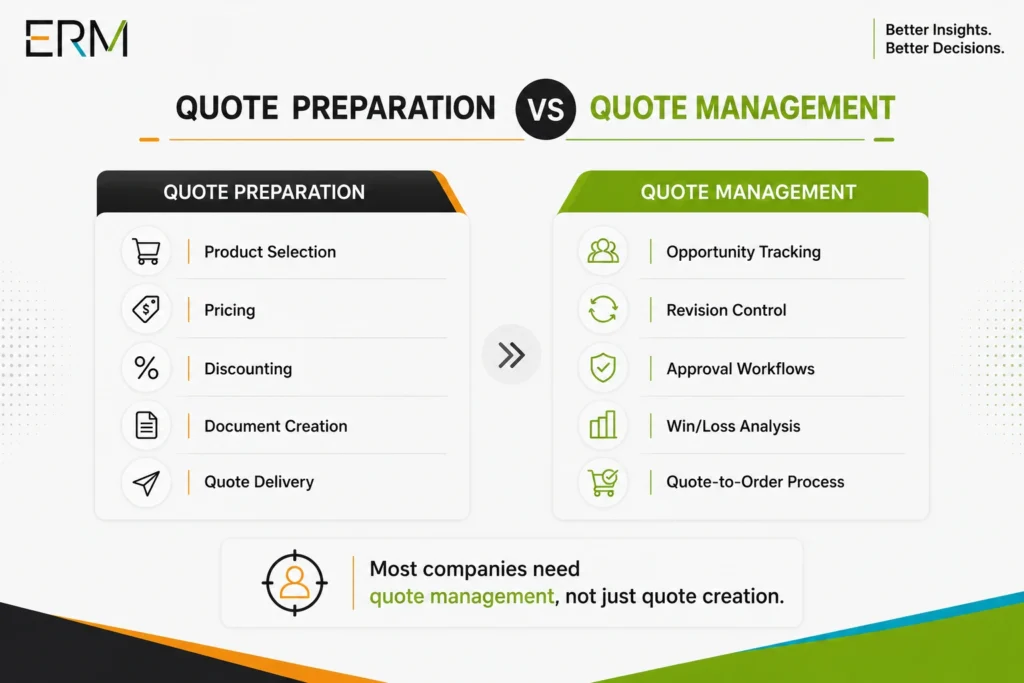
This is one of the most common arguments we hear in the field. At first glance, it sounds quite reasonable.
When preparing a quote, a sales representative needs access to:
Product information
Price lists
Inventory availability
Customer account information
All of this data typically exists in the ERP system. Therefore, it may seem logical to assume that quotes should also be prepared in ERP.
This approach is not entirely wrong. However, it is incomplete.
A sales representative does not need inventory information alone when preparing a quote.
They also need access to:
Customer history
Recent interactions
Open sales opportunities
Pending activities
Previous quotes
Competitor information
Historical sales prices
These types of information are often not the natural domain of ERP systems.
For this reason, especially in growing companies, quote preparation is no longer just a matter of accessing operational data. It becomes a matter of managing the sales process.
This is where the ERP-integrated CRM approach becomes more valuable.
The Biggest Challenge in Quoting Is Often Not Inventory, but Pricing Management
One of the most common arguments for preparing quotes inside ERP is inventory visibility.
However, especially in markets like Türkiye where prices can change frequently, the biggest challenge in quote management is often not inventory, but pricing control.
Many companies deal with issues such as:
Exchange rate fluctuations
Updated cost structures
Dealer pricing
Customer-specific pricing
Regional price differences
Profitability limits
Discount authorization rules
Campaign pricing
A sales representative does not only want to see whether a product is in stock.
They also need answers to questions such as:
What price was previously offered to this customer?
Am I authorized to apply this discount rate?
Is this quote below the minimum profitability threshold?
Does this quote require management approval?
At this point, quote management is no longer simply about entering a price.
It becomes a process that manages rules, approvals, and profitability.
In successful ERP-integrated CRM projects, approval workflows can be triggered automatically when predefined discount limits are exceeded.
Managers can review and approve quotes from their mobile devices.
Sales teams can access up-to-date pricing information in real time.
This structure improves sales speed while protecting pricing discipline.
For many companies, the real bottleneck in the quoting process is not access to inventory data, but the inability to properly manage pricing authority and profitability rules.

The Reality in Türkiye: ERP Interfaces Are Not Always Ideal for Sales Teams
Many mid-sized and large organizations in Türkiye have been using ERP systems for years.
However, most ERP platforms were originally designed as form-intensive operational systems for:
- Operations teams
- Accounting departments
- Procurement teams
- Manufacturing organizations
As a result, many ERP systems:
- Are not fully web-based
- Are not optimized for mobile use
- Were not designed with field sales teams in mind
- Require additional ERP licenses
- Can be complex from a user experience perspective
For operational teams, these capabilities are extremely valuable.
For a sales representative meeting customers in the field, the situation is different.
Sales teams typically need interfaces that are:
- Fast
- Simple
- Web-based
- Mobile-friendly
- Customer-centric
This is why ERP is not always the easiest environment for quote preparation.
In many cases, CRM systems integrated with ERP provide a more practical and efficient user experience.
The Natural Limitations of ERP Quote Modules
Most ERP systems include quote management functionality. This is perfectly natural.
However, managing pre-sales activities is not the primary purpose of an ERP system.
ERP platforms were built to manage:
- Inventory
- Orders
- Production
- Logistics and shipping
- Financial operations
As a result, ERP quote modules are often very effective at supporting basic quote creation.
However, limitations may emerge in areas such as:
- Multi-level approval workflows
- Alternative quote scenarios
- Revision management
- Sales opportunity integration
- Win/loss analysis
- Quote pipeline visibility
- Sales pipeline management
- Activity and customer interaction tracking
This does not mean ERP systems are lacking.
It simply means their priorities are different.
ERP and CRM systems were designed to solve different business challenges.
Three Common Company Profiles for Quote Preparation
| Company Profile | Typical Situation | Recommended Approach |
|---|---|---|
| Small businesses with simple sales processes | Limited product range, small customer base, low quote volume | Excel, ERP, or basic CRM quoting tools may be sufficient |
| Growing sales organizations | Increasing quote volume, frequent revisions, stronger customer follow-up requirements | CRM-based quote management becomes increasingly valuable |
| Mid-sized and large enterprises | Inventory visibility, pricing policies, credit risk controls, approval workflows, and order integration are business-critical | ERP-integrated CRM provides the most effective model |
This comparison highlights an important reality:
When selecting a quote preparation solution, companies should not focus solely on their current requirements.
They should also consider the direction in which their business is growing.
A solution that works today may become a bottleneck tomorrow as sales volume, customer complexity, and process requirements continue to increase.

What Does an ERP-Integrated CRM Add to the Quote Management Process?
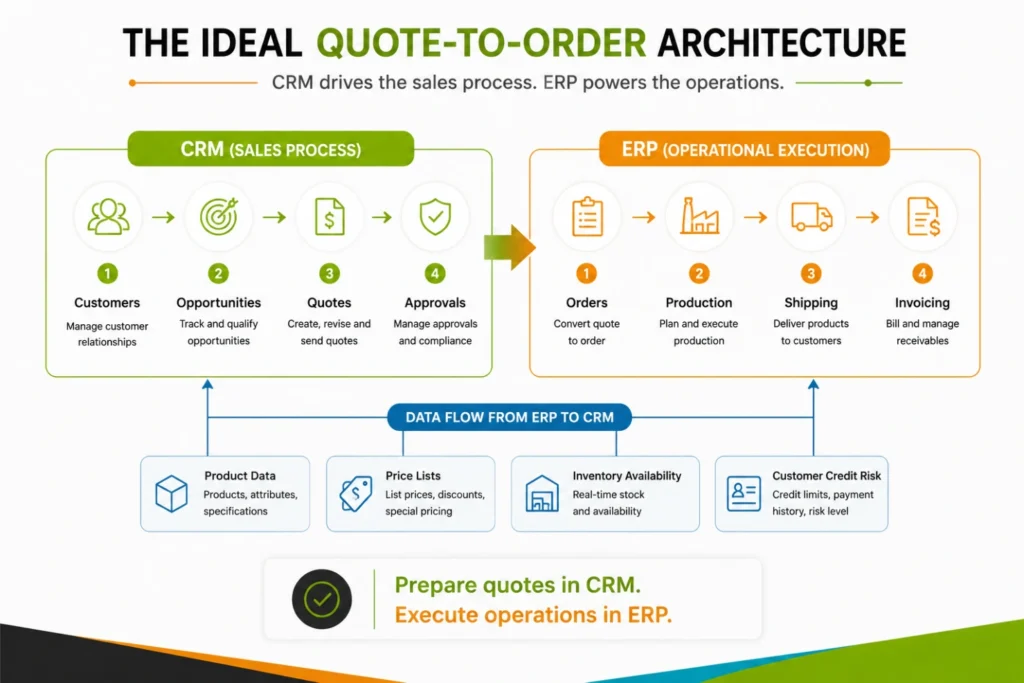
In an ERP-integrated CRM architecture, the quote management process is handled within the CRM platform.
However, critical operational data continues to be sourced directly from the ERP system.
This includes:
Product master data
Price lists
Inventory availability
Customer credit limits and risk information
Historical sales data
At the same time, the CRM platform manages:
Sales opportunities
Activities and follow-ups
Customer interactions
Quote revisions
Approval workflows
Quote performance metrics
This is where the real business value emerges.
Sales teams benefit from the speed and flexibility of CRM.
Operations teams benefit from the control and discipline of ERP.
How Should the Quote-to-Order Process Work?
In an ideal architecture, the process flows as follows:
A lead or customer is managed within the CRM system.
A sales opportunity is created.
The quote is prepared in CRM.
Product, pricing, inventory, and credit information are retrieved from ERP.
Approval workflows are completed.
The quote is sent to the customer.
Once approved, the quote is converted into an ERP sales order.
Production, shipping, invoicing, and collections continue within the ERP environment.
In this model, CRM manages the pre-sales process.
ERP manages the post-order operational process.
The ERM CRM Approach: Integrated Quote-to-Order Process Management
At ERM Information Technologies, we have spent more than 25 years helping organizations across various industries digitize their sales, service, and operational processes.
Throughout these projects, we have observed a recurring pattern:
Companies successfully implement ERP systems, gain control over inventory and financial operations, yet sales teams often continue to manage quotes through spreadsheets, email chains, and personal tracking methods.
The issue is rarely the ERP system itself.
The real challenge lies in bridging the gap between the flexibility required by sales teams and the operational discipline that ERP systems are designed to enforce.
This challenge has shaped the development philosophy behind ERM CRM.
Our goal is not to replace ERP systems.
Instead, we aim to enable sales teams to work efficiently without being dependent on ERP interfaces, while making ERP data a natural part of the CRM-driven sales process.
To support this vision, ERM CRM includes advanced quote and order automation capabilities developed through decades of real-world project experience.
Sales teams can manage customer interactions, sales opportunities, quote revisions, and approval workflows directly within CRM, while leveraging operational data such as product information, pricing, inventory levels, customer credit limits, and historical sales records from connected ERP systems.
Once approved by the customer, quotes can be converted into ERP sales orders without duplicate data entry.
Today, ERM CRM integrates with many of Türkiye’s most widely used ERP platforms, including Mikro, Logo, Netsis, SAP, IFS, Uyumsoft, ETA, Freedom ERP, and others.
This enables organizations to create a more visible, faster, and more manageable quote-to-order process while preserving the operational integrity of their ERP investments.
Our objective is not to compete with ERP systems, but to combine the operational strength of ERP with the customer-centric nature of CRM, helping sales teams move faster, managers gain greater visibility, and organizations maintain stronger process control.
The Real Question Is Not ERP or CRM
The real question is:
How can organizations provide the flexibility sales teams need while maintaining the operational discipline required by finance and operations?
For smaller organizations, Excel, ERP, or basic CRM solutions may be sufficient for a period of time.
However, as quote volumes increase, pricing rules become more complex, revisions multiply, and integration requirements grow, companies naturally move toward an ERP-integrated CRM model.
Because quotes sit at the center of the sales process.
Orders mark the beginning of the operational process.
CRM manages sales.
ERP manages operations.
An ERP-integrated CRM connects these two worlds.
And for most mid-sized and large organizations, the most effective architecture for quote preparation and quote management is not ERP alone or CRM alone, but a CRM platform tightly integrated with ERP.
Frequently Asked Questions
Frequently Asked Questions About the Quote Preparation Process
Should quotes be prepared in ERP or CRM?
For organizations with simple sales processes, ERP systems or even Excel may be sufficient for a period of time. However, as quote volumes increase, revisions become more frequent, and sales opportunities require structured management, CRM becomes the more effective solution. For mid-sized and large organizations, an ERP-integrated CRM model is typically the strongest approach.
Is quote preparation software the same as quote management software?
No. Quote preparation software primarily focuses on creating quotation documents. Quote management software, on the other hand, manages quotes alongside customers, sales opportunities, revisions, approval workflows, and performance tracking.
Can ERP inventory information be used within CRM quote screens?
Yes. In ERP-integrated CRM environments, product data, price lists, inventory availability, customer credit risk information, and historical sales data can all be accessed directly from CRM quote screens.
Can a quote prepared in CRM be converted into an ERP sales order?
Yes. Approved quotes can be converted into ERP sales orders. This allows the sales process to be managed in CRM while operational processes continue in ERP.
Why prepare quotes in CRM when an ERP quote module already exists?
Because CRM platforms provide stronger capabilities for sales-focused processes such as revision management, sales opportunity tracking, approval workflows, customer interactions, and quote performance analysis.
What are the risks of preparing quotes in Excel?
The most common risks include version confusion, pricing errors, limited visibility, and the inability to measure quote performance effectively across the organization.
What is the biggest advantage of an ERP-integrated CRM solution?
The greatest advantage is combining the speed and flexibility of CRM with the operational discipline of ERP. This creates a faster, more controlled, and more visible process from quote creation through order fulfillment.
Our expert is ready, Are you ready to explore ERM CRM?
See our all-in-one CRM solutions at work.
These might interest you.


Last Articles


Categories
- CRM Business (3)
- CRM Programı (1)
- CRM Software (8)
- Most Read (4)
Archives
- June 2026 (3)
- October 2025 (1)
- June 2025 (4)
- May 2025 (1)